in-progress, 2025~
In collaboration with Masayoshi Ishikawa (composer, piano) and dancers from Harrisonburg Dance Cooperatives
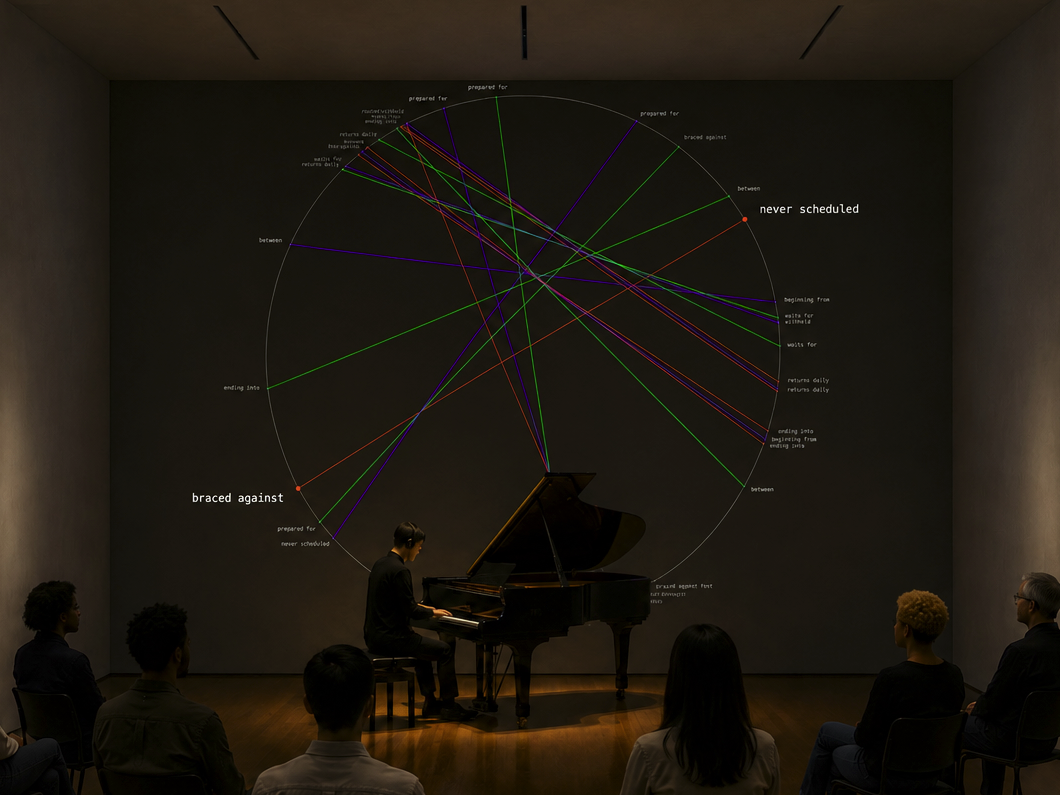
Distributed networked installation with six AI temporal lenses, live piano, spatial sound, video, sculptural elements, and machine-generated visual and sonic residues
Premiere: Duke Hall Gallery, Harrisonburg, Virginia, October 2026
Memory becomes legible across several temporalities at once. The conditions through which it is read keep shifting.
The work is anchored in six of Masayoshi Ishikawa’s memories, each tied to one of his compositions. They are held at its center, while machine perception, movement, material form, and live sound gather around them.
Six temporal lenses read around these memories. Each attends through one temporality, and together they span human, liminal, environmental, infrastructural, digital, and more-than-human time. They are formed from public context around the places and years of Ishikawa’s life. During the exhibition, live feeds of weather, tides, and flight paths from places along his life path press on each lens’s reading. Each lens judges whether its encounter converges, diverges, or drifts. What surfaces in the room as short captions and sound is a residue of the present seen through that lens. A lens speaks only when the present resonates with its register, and its silence is kept as a reading too. The same present never resolves into one account across the six. Visitors witness this drift.
Around this field, a video developed with dancers carries the memories into movement. Sculptural elements give them material presence. Ishikawa listens to the sonic residues of the six lenses and improvises at the piano. He answers what they sensed of the world he passed through.
One of two installations in the Keepsakes in Every Hair series. The other is Drift.
Exhibition developed with Masayoshi Ishikawa (composition and piano) and Seungho Lee (spatial design).