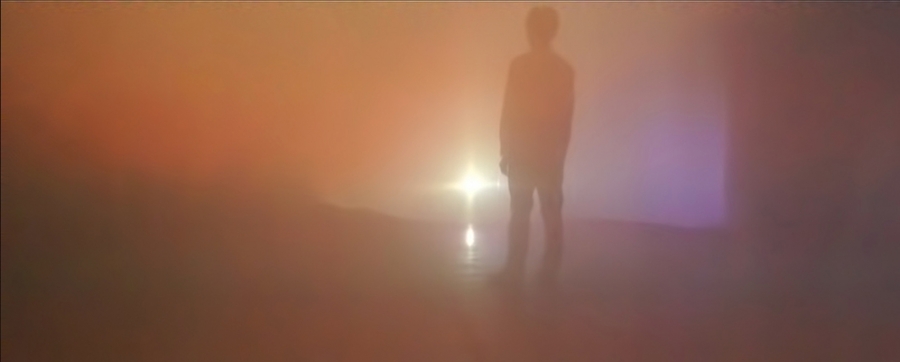
Sangjun Yoo is an artist and researcher working across installation, moving image, sound, and computational media. His work examines how perception, memory, and spatial orientation are shaped through shifting relations among time, environment, infrastructure, and technological systems.
Developed through doctoral research on perceptual mediation and extended through installation-based inquiry, Yoo’s practice treats perception as a distributed event that unfolds across human attention, environmental forces, and machinic processes. Using multi-channel video, spatial sound, environmental data, and custom computational frameworks, he creates responsive environments in which awareness is not given in advance but formed through instability, relation, and temporal change.
Yoo holds a Ph.D. in Digital Media and Experimental Arts from the University of Washington.
Areas of Interest
Yoo’s research moves through several related questions that have organized his practice over time. At its center is perception understood as relation: how seeing, hearing, and orientation form in the interval between perception and its surrounding conditions rather than inside either one. His work treats environment, light, architecture, and technological systems not as neutral settings but as active fields that structure and condition how perception takes shape, holding perception and its surroundings in a relation that is at once independent and complementary. From this follows a sustained attention to mediated temporality, to the ways delay, acceleration, and drift reorganize experience, translating time into spatial encounter and space into duration. More recently, in work engaging data and artificial intelligence, he treats computational systems not as tools but as perceivers in their own right, attending across timescales and registers that do not resolve into human ones, and approaches memory as already mediated and distributed rather than held privately. Across these concerns, environment and infrastructure appear less as background or material than as active media through which perception continues to form.